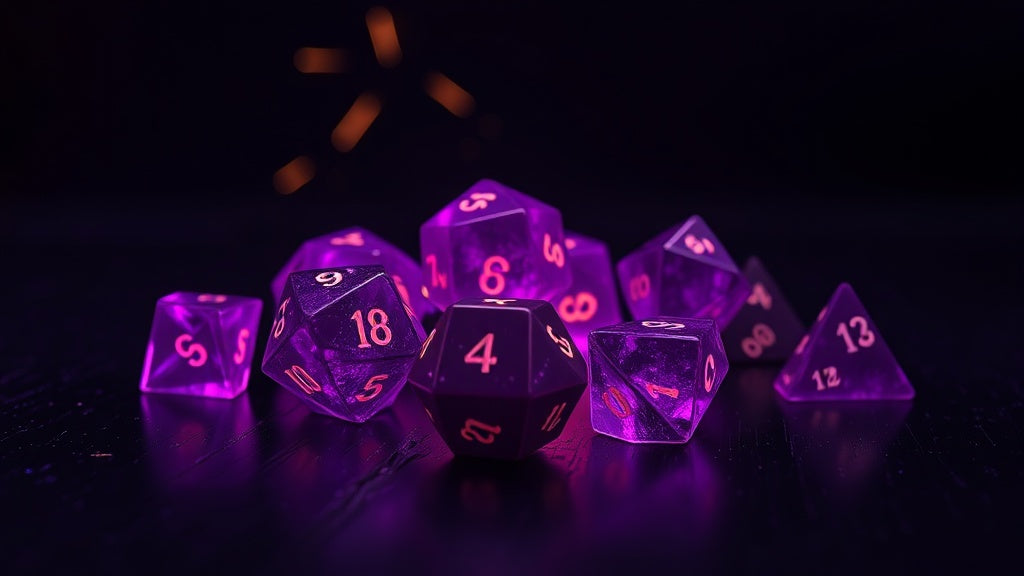
Buying your first set of dice for Dungeons & Dragons feels deceptively simple, until you open an online store and find thousands of options across half a dozen materials, sizes, edge styles and finishes. Your first set matters more than most people expect: it becomes your signature at the table, the dice you reach for on the big attack roll, and usually the start of a collection that grows for years. This complete guide walks you through every decision that actually counts, so your very first roll is also your best one.
Why your first dice set matters
Every long-time player remembers their first set. There is an emotional, almost superstitious bond between a player and their dice, and that bond starts the moment you pick a set that feels like yours. Beyond sentiment, a good first set quietly teaches you what you like: the weight in your palm, the colour under table light, the edge style and the readability that suit your eyes and your group. Get it right and you will happily roll the same set for years. Get it wrong and you will be back shopping within a week, which is fine too, that is how collections are born.
The good news is that you do not need to spend a fortune to get a fantastic first set. You simply need to understand the handful of variables that drive quality and feel, and then match them to how and where you actually play. Let us walk through each one.
Material: resin, metal or gemstone

Material is the single biggest decision because it changes the price, the weight, the sound and the entire look of your dice.
- Resin is the all-rounder and the right pick for most beginners. It is light, quiet on the table, available in an enormous range of colours, and affordable. Modern sharp-edge resin is hand-poured and pressure-cured for crystal clarity, with crisp facets that show off glitter, swirls and inclusions.
- Metal brings real heft and a deeply satisfying clack. Metal dice are near-indestructible and feel incredible in the hand, but they are heavier, louder, and pricier. They make a brilliant statement set or gift, just roll them on a tray to protect your table.
- Gemstone is the luxury tier. Cut from natural stone, gemstone dice are cool to the touch and genuinely one-of-a-kind, since no two pieces of stone are identical. They are a collector's centrepiece rather than a first-timer's daily driver.
If you are unsure, start with sharp-edge resin. It gives you the best balance of price, looks and everyday usability, and you can always add a metal or gemstone showpiece later once you know what you love. For a deeper comparison, read our breakdown of metal vs resin vs gemstone dice.
Sharp edge vs rounded edge
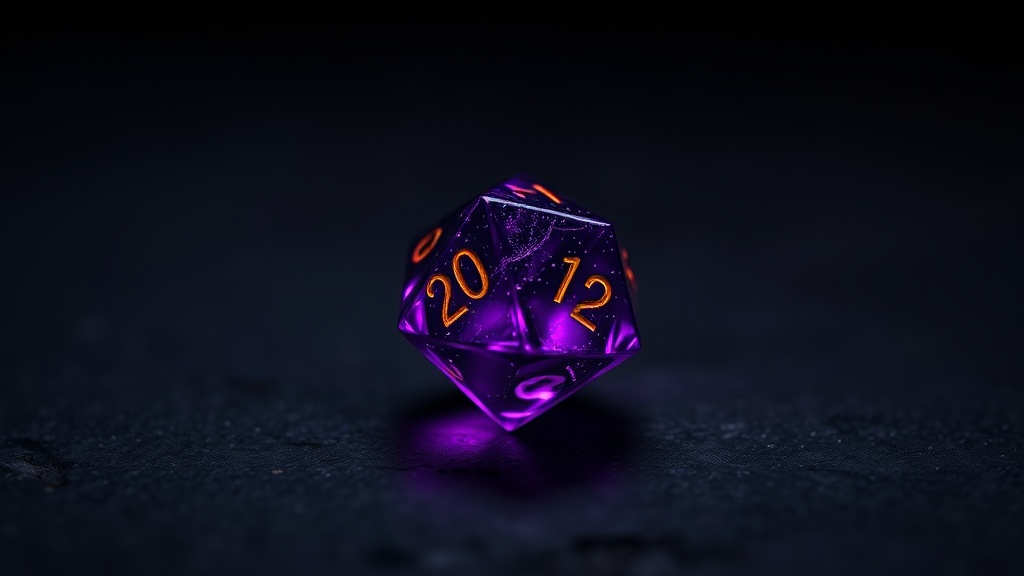
Dice come in two broad edge styles, and the difference is bigger than it looks. Rounded-edge dice (the classic, mass-produced look) have softened corners and tumble easily, they are cheap and cheerful but rarely premium. Sharp-edge dice have crisp, defined facets that look far more luxurious and read cleaner across the table. Sharp-edge resin is the modern collector standard, and once you have rolled a sharp-edge set it is hard to go back. The only trade-off is that sharp-edge dice are usually hand-finished, so they cost a little more, money well spent for your hero set.
Size and readability

Standard polyhedral dice are 16mm. Go smaller and the numbers become hard to read across a table; go much bigger and they will not fit in a dice tray or tower. Unless you have a specific reason (oversized statement dice for drama, or mini dice for travel), stick to 16mm, it is the size every accessory is built around.
Readability is where a lot of cheap sets fall down, and it is the thing beginners most often overlook. Look for deep-inked numbers with high contrast against the body colour. Translucent dice look gorgeous in product photos but can be a nightmare to read in the low, candle-lit lighting of an atmospheric session. If you game at night, in basements, or at noisy conventions, prioritise contrast over fancy translucency every time. A quick test: if you can read the d20 at arm's length under a dim lamp, it will read fine at the table.
Balance and fairness
A fair die rolls every face with roughly equal probability. Cheap, mass-produced dice often have air bubbles, uneven walls or lopsided numbering that quietly skew your results, and over a long campaign those small biases add up. You do not need a laboratory to avoid this, just look for a few quality signals:
- Pressure-cured resin with no visible internal bubbles when you hold it to the light.
- Crisp, even edges on every face, with no soft, mushy or filed-down corners.
- Numbers that sit flush and even, inked fully, not lopsided or half-filled.
Reputable makers pressure-cure their resin specifically to eliminate bubbles, which is why a slightly more expensive set from a real dice brand will usually out-roll a bargain-bin pack. If you want to test a set at home, fill a glass with water, add salt until a die floats, then flick it, a heavily biased die will keep showing the same numbers face-up.
Colour and personality

This is the fun part. Your dice are an extension of your character, so pick a colourway that fits the vibe you want at the table: arcane purples for a wizard, smoky blacks for a rogue, radiant golds for a paladin, blood reds for a barbarian. We break this down fully in our guide to the best dice colours for every D&D class, but the short version is simple, pick the set that makes you grin when you roll it. That grin is worth more than any spec sheet.
Setting a budget
You can spend anywhere from a few dollars to well over a hundred on dice, so it helps to set expectations. A quality sharp-edge resin set usually lands in a comfortable mid range, premium enough to be balanced and beautiful, affordable enough that you will not panic if you lose one under the sofa. Metal sets cost more because of the material and engraving, and gemstone sets command the highest prices because each is hand-cut from natural stone. For a first set, spend a little more than the absolute cheapest option (cheap dice are a false economy) but you do not need to splurge on metal or gemstone until you are sure you are sticking with the hobby. Bundles are the smart play if you want more than one set: ours give you the third set free when you buy two, which is the best value-per-set you will find.
Where to buy, and what to avoid
Buy from a maker or curator that specialises in dice and stands behind them. Look for clear photos of the actual product (not just renders), readable contrast, a stated material, and a returns or warranty policy. Be wary of ultra-cheap marketplace listings with stock photos, they are often the bubbly, unbalanced sets that put people off. A good store will tell you the material, the edge style and the size up front, and will back the purchase with easy returns. Our metal dice, for example, carry a lifetime warranty against manufacturing defects, and every order ships fast from the USA with free shipping over $35.
Common beginner mistakes
- Choosing looks over readability. A stunning translucent set you cannot read at night will frustrate you every session.
- Buying the cheapest possible pack. Bubbles, soft edges and bias make for a poor (and unfair) first impression.
- Rolling metal or gemstone on a bare table. Use a tray or tower, your furniture and your dice will both last longer.
- Forgetting accessories. A dice bag and a rolling tray cost little and dramatically improve the experience.
How many dice do you actually need?
One complete 7-piece polyhedral set is enough to play. It includes a D20, D12, two D10, D8, D6 and D4, every die the game asks for. If you want the full breakdown of what each die does, read what dice you need for D&D. Most players eventually own several sets (one per character, or just because they are beautiful), but you only need one to start, and a single great set beats five mediocre ones.
Our recommendation for beginners
If you want a single, no-overthinking recommendation: choose a sharp-edge resin 7-piece set, 16mm, in a high-contrast colourway, from a maker that backs it with a warranty. That is the sweet spot of price, readability and longevity, and it is exactly what we curate in our beginner dice sets. Add a soft dice bag to keep it safe, and you are ready for your first session.
Frequently asked questions
How much should I spend on my first dice set? Enough to avoid the cheapest bubbly packs, but you do not need metal or gemstone yet. A mid-range sharp-edge resin set is ideal.
Are expensive dice more accurate? Not automatically, but quality makers pressure-cure resin and finish edges precisely, which produces fairer rolls than cheap mass-produced dice.
What size dice should I buy? Standard 16mm. It reads well at the table and fits every tray, tower and bag.
Do I need more than one set to play? No, one 7-piece set is all you need. Many players collect more for variety or to roll big spells faster.
Whatever you choose, remember the most important rule: the best dice are the ones you love rolling. Browse the full armoury and find your first set. Gear up. Roll to win.