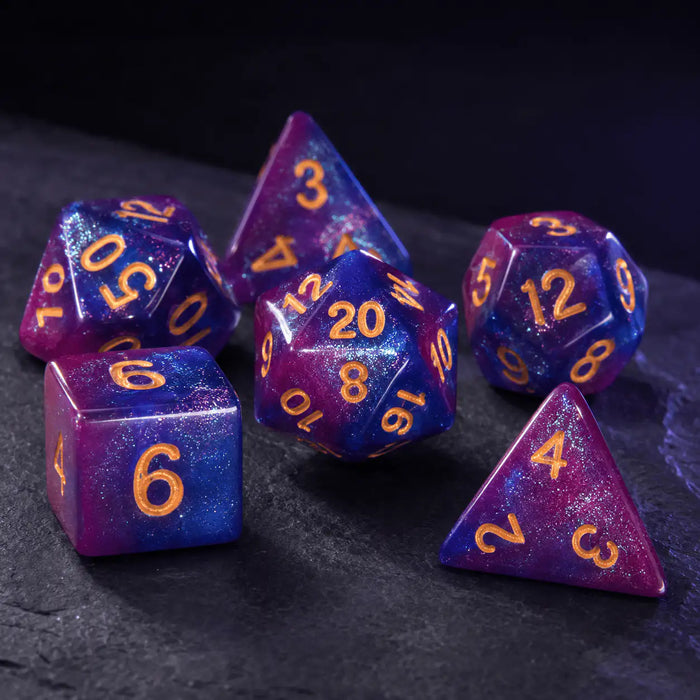
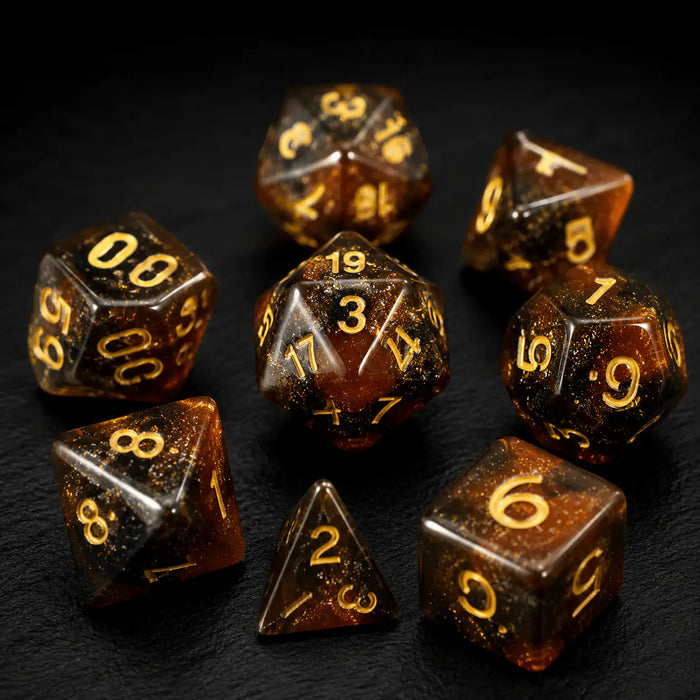
Blue & Gold Nebula Dice Set
$19.00
Walking into your first session of Dungeons and Dragons can feel overwhelming, and the dice are often the first hurdle new players face. If you have ever stared at a pile of strangely shaped dice and wondered which one to grab, you are in the right place. A good beginner dice set gives you exactly what you need to roll, calculate, and play without owning a single die more than necessary. Every set in this collection is hand-picked for clarity, durability, and the kind of readability that keeps the game moving instead of slowing it down while you squint at tiny numbers.
Whether you are buying your very first set, replacing a missing die, or shopping for a friend who just joined a campaign, this collection is built around one idea: a great starter DnD dice experience should be simple, beautiful, and ready for the table on day one. Below we cover everything a new player needs to know.
Almost every first dice set for Dungeons and Dragons follows the same standard: seven polyhedral dice, each with a different number of sides. These seven shapes cover every roll the game asks of you. Understanding what each die does is the single fastest way to feel confident in your first session. Here is the full lineup of beginner polyhedral dice and what each one is for:
Once you can name all seven on sight, you have cleared the biggest beginner barrier. Everything else is just practice.
One of the most common questions we hear is simply: how many dice for DnD do you actually need to start? The honest answer is that a single 7-piece polyhedral set is enough to play every class at level one and well beyond. This makes a complete set the ideal dice set for new players, because nothing is missing and nothing is wasted.
That said, as you level up you may want a few extras. Spellcasters and rogues roll many dice at once, so a handful of additional D6s or D8s speeds up big damage rolls. A second full set is also handy as a spare. But none of that is required to begin. Start with one quality set and expand only when your character's needs grow. Our how to play Dungeons and Dragons guide breaks down exactly which dice each class leans on most.
The best beginner dice set is one you can read instantly and enjoy holding. Three factors matter most when you choose your first set:
Browse our full lineup in the complete dice collection if you want to see every option side by side, or jump straight to a popular beginner favorite like the Blue Gold Nebula dice set, a swirling resin set with crisp, easy-to-read numbers.
Material affects how a die looks, sounds, feels, and rolls. Here is a quick guide to help you pick the right one for your first purchase and your future collection:
For a first set, resin is hard to beat on value and readability. Metal makes a wonderful second set or a memorable upgrade once you are hooked.
Reading beginner polyhedral dice is mostly intuitive, with two small exceptions. On the D4, the result is the number that appears upright on all three visible faces, or the number at the bottom edge, so check which style yours uses. On the percentile pair, roll the D% and the D10 together: the D% gives the tens digit and the D10 gives the ones digit, so a 40 and a 7 read as 47, while 00 and 0 read as 100. For every other die, the number facing up is your result. After a session or two, this becomes second nature.
A few simple table manners keep the game friendly and the rolls fair. Following them marks you as a thoughtful player from your very first session:
None of this is hard, and most groups will happily show a newcomer the ropes. A dedicated set of your own, kept in a dice bag, makes following these courtesies effortless.
Every great dice collection starts with one set. Many players assign a special set to each character, choosing colors that match a personality or backstory. Others collect by material, hunting down a metal, gemstone, or liquid-core set to mark a milestone. A standout option for a second purchase is the Dragon sharp-edge dice set, whose razor-crisp faces and bold numbers roll like a dream.
As your collection grows, keeping it organized becomes part of the fun. A quality dice storage solution protects your sets and keeps them sorted, so you are never digging for the right D20 at the start of a session. To see what is worth adding next, check our roundup of the best DnD dice for 2026.
Dice make one of the best gifts in the hobby because they are personal, affordable, and instantly useful. A complete 7-piece set is a thoughtful present for anyone joining their first campaign, and choosing a color that suits the recipient turns a small gift into something memorable. If you are not sure what they already own, a full set is always safe, since most players are happy to have a spare. For more inspiration, visit our gifts for DnD players collection, and explore the wider hobby through our tabletop news and guides blog.
A single 7-piece polyhedral set is enough to play any class from level one onward. That set includes a D4, D6, D8, D10, D%, D12, and D20, which covers every roll the game requires. Extra D6s or a second set are nice to have at higher levels but are never required to begin.
Resin is the ideal choice for most beginners. It is lightweight, affordable, durable, and comes in the widest variety of readable colors. Metal sets are a great premium upgrade or second set once you are sure the hobby is for you.
The D% is a second ten-sided die marked in tens (00 through 90). You roll it together with the standard D10 to generate a number from 1 to 100, which is used for percentile rolls on random tables and certain in-game effects.
Absolutely. A quality starter set will serve you for years of campaigns. Many experienced players still use the very first set they bought. As your collection grows, you simply add new sets for new characters rather than replacing your trusted starter.
Yes. A standard 7-piece polyhedral set works for Pathfinder and most tabletop RPGs, and the D20 and D6 are useful across many games including counters and rolls in card games. One good set is a flexible foundation for the whole hobby.