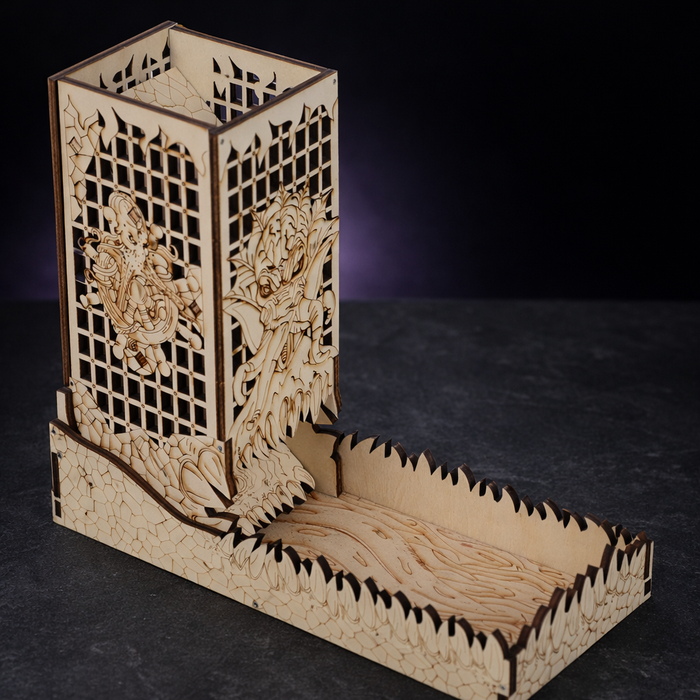
CZYY Mind Flayer Laser Etched Wood Dice Tower with Tray
See price on Amazon
 Buy on Amazon
Buy on Amazon
Buy on Amazon
Buy on Amazon
Buy on Amazon
Buy on Amazon
Buy on Amazon
Buy on Amazon
Buy on AmazonThere is a moment at every table when someone reaches for the dice, cups them in two hands, shakes a little too hard, and lets them tumble across the map. Half of them slide off the edge. One lands cocked against a miniature. Another disappears under the pizza box. And then the debate begins: does that count? A good dice tower ends that debate before it starts. It takes the human hand out of the equation, sends each die clattering down a series of internal baffles, and drops it into a contained space where the result is plain, visible, and impossible to argue with. That is the whole promise of this curated selection of dice towers, and it is why so many players who thought a tower was a novelty end up refusing to game without one.
This collection gathers dice towers built for people who actually play, not just people who collect. Every tower here has been chosen because it does the two things a tower is supposed to do: it randomizes honestly and it keeps your rolls from scattering across the room. Beyond that baseline, the range opens up into a satisfying spread of materials, sizes, and mechanics so that whether you run a heavy campaign three nights a week or bring a bag of dice to a friend's kitchen table once a month, there is a tower shaped to how you play.
The case for a tower is partly about fairness and partly about peace at the table. When you throw dice by hand, you introduce dozens of tiny variables: the height of the drop, the spin off your fingers, the friction of the surface, even the deliberate little wrist tricks that some players swear they do not do. Loaded intent aside, hand rolling simply is not consistent, and inconsistency is the enemy of trust. A dice tower solves this by forcing every die through the same path. The die enters the top, bounces off internal ramps set at angles designed to break momentum and tumble the cube, and exits at the bottom having been thoroughly randomized by physics rather than by hand. The result is a roll that everyone at the table can accept without a second glance.
The second benefit is containment, and anyone who has ever hunted for a runaway d20 under the couch understands it immediately. Most towers here feed into an attached tray or a catch basin, so the dice stop where they land instead of bouncing off the table, knocking over standees, or vanishing into carpet. That containment matters even more when you play on a nice surface. A tower protects your finished game board, your painted terrain, and your table from the constant micro impacts of dice being thrown down hour after hour. If you care about your setup, a tower is quietly one of the most protective accessories you can own.
There is also the sensory side, which players rarely mention until they experience it. A well built wooden tower produces a warm, rolling knock as the dice descend, a sound that becomes part of the ritual of the game. An acrylic tower gives you a sharper, brighter rattle and the pleasure of watching the dice cascade through a transparent shaft. These are small things, but games are made of small things, and the right tower turns a mechanical necessity into a moment you look forward to.
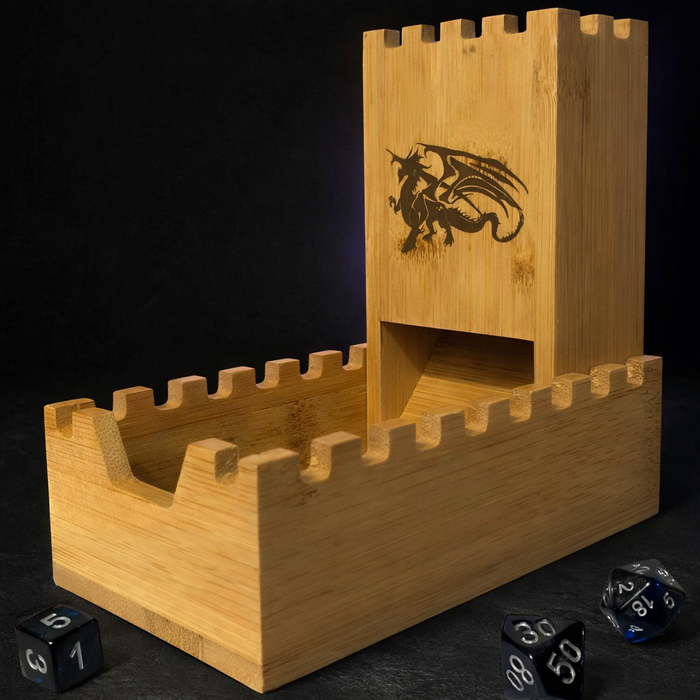
Material is the first real decision, because it shapes both how a tower feels and how it fits your table. Wooden dice towers are the classic choice and for good reason. They carry weight, they age beautifully, and their laser cut joinery often doubles as decoration, with etched dragons, dungeon motifs, arcane sigils, or clean geometric paneling worked directly into the sides. A wood tower sits on a table like a piece of furniture that happens to roll dice. Many of the wooden models in this collection knock down flat for storage and slot back together in seconds, which is a genuinely clever trick when shelf space is tight.
Acrylic and transparent towers take the opposite approach. Instead of hiding the mechanism, they show it off. You watch the dice ricochet down through the clear or tinted panels, and there is a small theatrical thrill in seeing a critical hit form before it hits the tray. Acrylic tends to be lighter, easy to wipe clean, and often available in bold colors or smoky translucents that suit a modern setup. For players who want their gear to have visual personality, an acrylic tower earns its place.
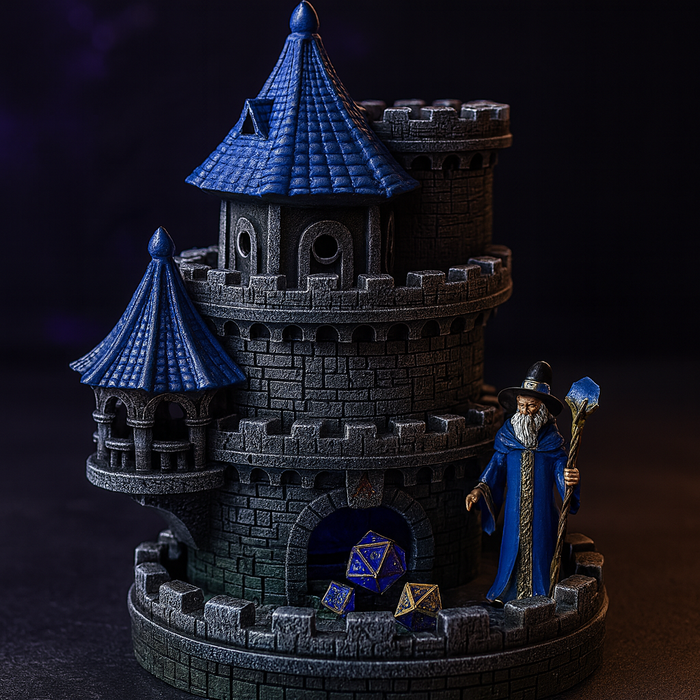
Between those poles you will find hybrids and specialty builds: metal accented towers with real heft, folding leather and faux leather towers that collapse into a slim wallet for travel, and compact resin models designed to disappear into a dice bag. The point of offering this range is simple. The best tower is the one you will actually use, and that depends entirely on how and where you play.
Not every game happens at a dedicated table. Plenty of the best sessions occur at a coffee shop, on a train, in a dorm room, or squeezed onto a corner of a busy kitchen counter. For those players, a foldable dice tower is a small revelation. These collapsible designs flatten into a thin panel or fold into a compact case, then pop open into a fully functional tower in seconds. Many of them integrate a folding tray, so the whole rolling station tucks into a backpack pocket and deploys wherever you happen to land.
Travel towers ask you to trade a little of the heft and resonance of a solid wood model for portability, and for a lot of players that trade is obvious. A foldable tower that lives permanently in your dice bag means you always have fair, contained rolls no matter whose table you end up at. If you are the person who hosts at other people's houses or runs games at a local shop, this is very likely the category for you.
A tower alone randomizes your roll, but a tower with an integrated tray gives you a complete, self contained rolling station. The tray catches the dice as they exit, presents them in a clean framed space, and keeps the result tidy and readable. Some of the models here feature removable trays, felt lined bases that quiet the landing, or trays that double as dice storage between sessions. This all in one approach is ideal if you want a single object that handles rolling, containment, and presentation without extra pieces to keep track of.
If you already own rolling surfaces, or you like to mix and match, it is worth pairing a tower with dedicated dice trays so you can build a station that suits your exact setup. A larger standalone tray gives multiple players room to roll into a shared space, while a compact personal tray keeps each player's dice in their own lane. The tower handles fairness, the tray handles the aftermath, and together they turn a chaotic tabletop into an orderly one.
With the materials and features in mind, picking your tower comes down to a few honest questions about how you play. Start with volume. If you roll fistfuls of dice at once, as damage heavy characters and dice pool systems often do, look for a taller tower with a wider throat and a generous tray so a full handful can descend and land without jamming or overflowing. If you mostly roll one or two dice at a time, a compact tower is faster to set up, easier to store, and perfectly sufficient.
Next, think about where the tower will live. A permanent home on a game room table can support a large, heavy, statement piece wooden tower. A tower that shares space with your dinner and gets packed away nightly is better served by a folding or knock down design. Then consider sound. Wood muffles and warms the roll, felt lined trays quiet it further, and bare acrylic amplifies the rattle. Some players love the clatter, others game late at night next to sleeping housemates and want the quietest possible drop. There is no wrong answer, only the answer that fits your room.
Finally, let aesthetics count. This is gear you will look at across dozens or hundreds of sessions, and the tower that matches the mood of your game, whether that is grim dungeon crawl, high fantasy, cyberpunk neon, or clean modern minimalism, is the tower you will be proud to set down in front of your friends. Every option in this collection was selected to hold up to that scrutiny, so you can choose on style knowing the fundamentals are already sound.
A dice tower rarely lives alone. It is one node in a rolling ecosystem, and the more thoughtfully you assemble that ecosystem, the smoother every session runs. Pair your tower with a matched tray for containment, keep a dedicated set of dice reserved for tower rolls so they never wander, and consider how the whole kit stores and travels together. Players who enjoy the craftsmanship of a physical tower often also appreciate the artistry of a well designed maker built dice towers range, which pairs naturally with the affiliate options gathered here and lets you compare handcrafted originals against the broader market in one place.
It is also worth remembering that a physical tower and a digital roller are not rivals. They serve different moments. When you are gaming remotely, prepping encounters solo, or simply want to settle a quick check without setting up your gear, a free dice roller gives you instant, provably fair results from any device. Many players keep both close at hand: the tower for the tactile ritual of the table, the digital roller for speed and portability. Together they cover every situation you are likely to face, from a full weekend campaign to a five minute rules dispute over text.
The towers in this collection were not chosen to look good in a photo and then fall apart after a month of use. They were chosen because they hold up. Sturdy joinery, stable bases that do not tip when you drop a handful of dice, internal baffles positioned to actually tumble the cubes rather than let them slide straight through, and trays sized to catch what the tower throws. These are the details that separate a tower you love from a tower you quietly retire to a shelf. Where a tower folds or knocks down, the connections are designed to stay tight through repeated assembly. Where it stands permanently, the weight is there to keep it planted.
Durability matters because a dice tower is a long term companion. Buy the right one and it will outlast campaigns, survive moves, endure being packed and unpacked hundreds of times, and still deliver the same honest roll on its thousandth use as it did on its first. That longevity is the real value. A tower is a small purchase that quietly improves every game you play for years, removing arguments, protecting your table, and adding a little ceremony to the moment the dice fall.
Fair rolls, contained dice, a protected table, and a satisfying ritual every time you play: that is what the right dice tower delivers, and this collection was built to help you find yours. Whether you are drawn to the warmth and craftsmanship of a wooden model, the modern clarity of acrylic, the convenience of a folding travel design, or the completeness of a tower with an integrated tray, there is an option here matched to your table and your style. Take a moment to browse the full range, weigh the material and the size against how you actually play, and pick the tower that will end the dice arguments at your table for good. Round out your setup with matching dice trays, explore the maker built dice towers for handcrafted alternatives, and keep a free dice roller bookmarked for the moments you game away from your gear. Your next great roll is one drop away, so choose your tower today and make every result one nobody can dispute.