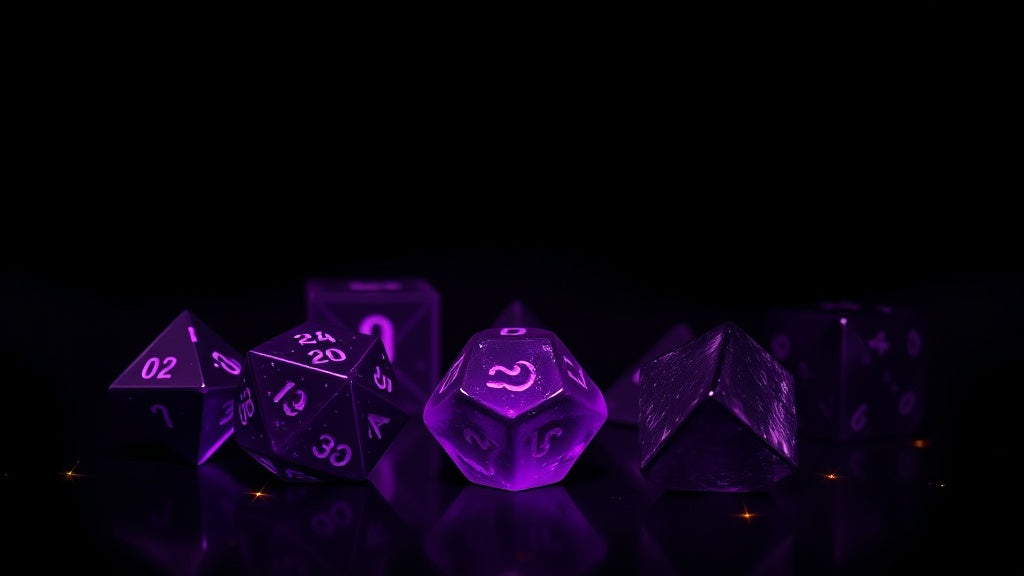
If you are brand new to Dungeons & Dragons, the dice can look intimidating, all those shapes and numbers, plus people casually saying things like "roll a d20" or "2d6 plus your modifier". The truth is wonderfully simple: a standard set has seven dice, and once you know what each one does, you will never be confused at the table again. This guide breaks down the complete polyhedral set, what each die is for, how to read dice notation, and how many sets you really need.
What is a polyhedral dice set?
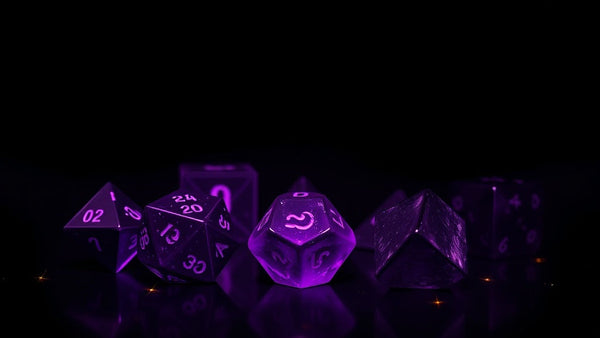
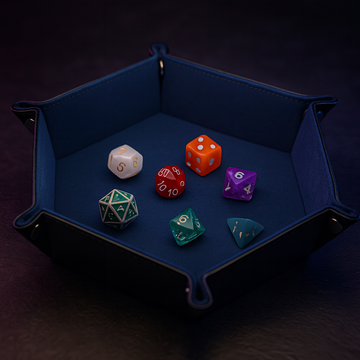
A polyhedral dice set is the standard 7-piece collection used in D&D, Pathfinder and most tabletop RPGs. "Polyhedral" just means "many-sided", and the set covers every die the rules will ever ask you to roll. When someone says they bought "a set of dice", this is what they mean. Each die is referred to by the letter d (for die) followed by its number of sides, so a twenty-sided die is a "d20" and a six-sided die is a "d6". Simple as that.
The seven dice and what each one does

- D20 (twenty-sided) - the star of the show. You roll it for attack rolls, saving throws and ability checks. A natural 20 is a critical hit; a natural 1 is a critical miss. More than any other die, this is the D&D die.
- D12 (twelve-sided) - the big damage die. Greataxes and barbarians love it; it shows up for heavy weapons and some class features.
- D10 (ten-sided) - used for damage and, crucially, for percentages. That is why a set includes two d10s: one marked 0-9 (units) and one marked 00-90 (tens). Roll them together for a "percentile" (d100) result from 1 to 100.
- D8 (eight-sided) - a workhorse for many weapons (longswords) and spells.
- D6 (six-sided) - the familiar cube, used for common damage rolls and many spells (fireball rolls a lot of d6s).
- D4 (four-sided) - the smallest, used for daggers, healing potions and minor effects. Famous for being painful to step on.
How to read dice notation (2d6 + 3)
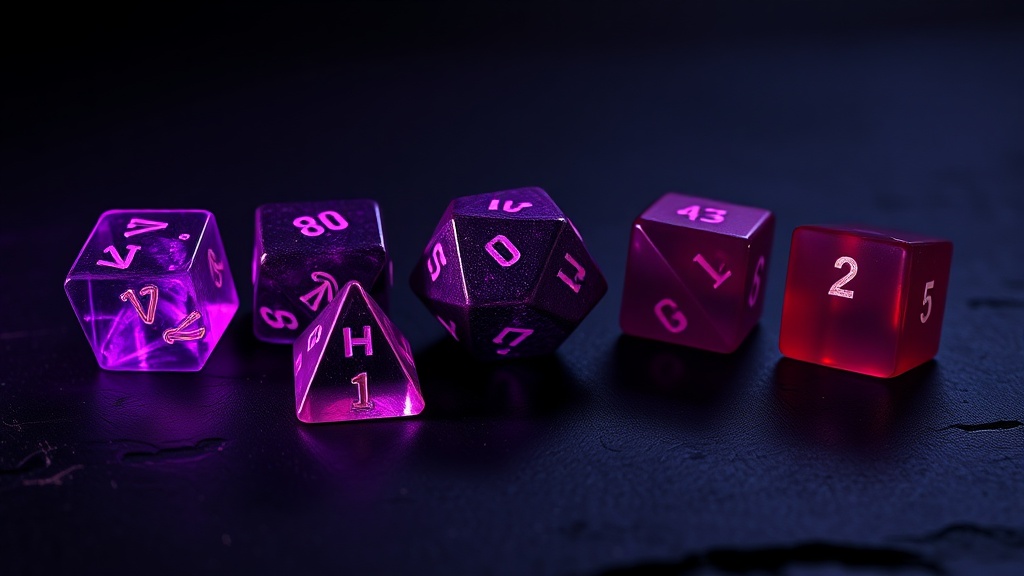
You will constantly see shorthand like 2d6 + 3. It breaks down simply: the first number is how many dice to roll, the letter d means die, the second number is which die, and the bonus on the end is a modifier you add to the total. So "2d6 + 3" means roll two six-sided dice, add them together, then add 3. "1d20 + 5" means roll one d20 and add 5. "8d6" (a classic fireball) means roll eight six-sided dice and total them. That single piece of notation is the entire dice language of the game, learn it once and every rulebook and spell card makes sense.
Advantage, disadvantage and the d20

One d20 rule trips up almost every beginner: advantage and disadvantage. When you have advantage, you roll two d20s and keep the higher result; with disadvantage, you roll two and keep the lower. This is why having a couple of matching d20s (or a full second set) is genuinely handy, you can roll both at once instead of rolling the same die twice. Many players keep a spare d20 nearby just for this.
Common rolls by situation
Here is how the dice show up in a typical session, so the shapes start to feel familiar:
- Attacking: d20 to hit, then a weapon die (d4 to d12) for damage.
- Casting a spell: often a d20 to hit or a saving throw, then damage dice like d6 or d8, sometimes many at once.
- Skill checks and saves: d20 plus your modifier.
- Random tables and loot: percentile (the two d10s) for "roll d100" outcomes.
- Healing: often d4 or d8 (potions and hit dice).
Do you need more than one set?

To play, you need exactly one 7-piece set. That is it. However, there are good reasons many players own several:
- One set per character, so your wizard and your barbarian each have their own identity and their own luck.
- Casting lots of dice at once. Spells like fireball ask for 8d6, and rolling eight d6s together is far faster (and more satisfying) than rolling one die eight times. Extra d6s are genuinely useful.
- Advantage and disadvantage, as above, a second d20 speeds things up.
- Because they are beautiful. Let us be honest, dice collecting is half the hobby.
Physical vs digital dice
Plenty of online tools and virtual tabletops will roll dice for you, and they are convenient for remote games. But most players agree that nothing beats the ritual of physical dice, the weight, the rattle, the suspense as the d20 settles. Digital dice are great as a backup or for play-by-post games; physical dice are the heart of the in-person experience. Many groups use both: real dice at the table, an app when someone forgets theirs.
Buying dice for a whole group
If you are kitting out a new campaign or running a one-shot for friends, make sure everyone has their own set, sharing dice slows the game and nobody likes waiting. A multi-set bundle is the most economical way to do this, and ours give you the third set free when you buy two, perfect for outfitting a party of three or more. Pair each set with a dice bag and you have ready-made gifts for the table.
Tips for your very first session
Knowing your dice is one thing; using them smoothly at the table is another, and a few habits make your first game far less daunting. Keep your seven dice grouped where you can see them so you are not hunting for the d8 while everyone waits. When the DM calls for a roll, listen for two things: which die, and what to add, "make a Dexterity saving throw" means roll the d20 and add your Dexterity save modifier. Roll on the table (or a tray) where everyone can see the result, table etiquette frowns on rolls that vanish into your lap. If you are casting a spell with lots of dice, like a fireball's 8d6, gather all your d6s and roll them together to save time. And do not stress about getting it perfect: every experienced player was once the newcomer squinting at their dice, and the table will happily help you learn. Within a session or two, reaching for the right die becomes second nature.
A quick history of polyhedral dice
Dice are ancient, humans have rolled bones, stones and carved cubes for thousands of years, but the full set of polyhedral shapes we use today became standard with the rise of tabletop roleplaying in the 1970s. The five Platonic solids (the d4, d6, d8, d12 and d20) are mathematically "fair" shapes where every face is identical, which is exactly what you want for unbiased rolls. The d10 was added later to make percentile rolls easy. That blend of ancient geometry and modern gaming is part of what makes a set of dice feel special: you are rolling shapes the Greeks studied, to decide whether your rogue picks the lock.
Dice for other tabletop games
The good news is that one polyhedral set covers far more than D&D. Pathfinder, the most popular D&D alternative, uses exactly the same seven dice. Many other RPGs lean on subsets, some systems are "d6 only", others use lots of d10s, but if you own a standard 7-piece set (or a few), you are equipped for the overwhelming majority of tabletop games. Buying a quality set is therefore an investment across your whole hobby, not just one game.
Choosing your first set
Now that you know what you need, the next question is what to buy. For most new players, a sharp-edge resin beginner set with high-contrast, easy-to-read numbers is the perfect starting point. If you want the full decision guide, read how to choose your first dice set.
Don't forget the accessories
A couple of small additions make game night smoother: a dice bag to carry and protect your set, and a dice tower or rolling tray to keep rolls fair and on the table. Neither is essential to play, but both quickly become things you would not want to game without.
Frequently asked questions
How many dice are in a standard D&D set? Seven: a D20, D12, two D10 (units and tens), D8, D6 and D4.
Why are there two d10s? One is marked 0-9 and one 00-90, so you can roll them together for a percentile (1-100) result.
What does 2d6 mean? Roll two six-sided dice and add them together. Any modifier (like "+3") is added afterwards.
Do I need a special d20 for advantage? No, but having two d20s lets you roll advantage and disadvantage in one throw instead of rolling the same die twice.
That is everything a new player needs to know about dice. Grab a complete 7-piece set, learn the notation, and you are ready to roll your first character. Gear up. Roll to win.