If you have ever cracked open a Dungeons & Dragons rulebook, a spell description, or a character sheet, you have run into something like 8d6, 2d6, or 1d20. That string of a number, a letter, and another number is called dice notation, and it is the language D&D uses to tell you exactly which dice to roll and how many of them. Once you learn how to read it, the entire game opens up: you will instantly understand spell damage, weapon damage, healing, and ability score generation without flipping back to the rules.
This guide breaks down dice notation from the ground up. We will cover what NdX means, how to read every common notation, what specific rolls like 8d6 and 2d6 actually mean, how modifiers and "drop lowest" work, and we will finish with a handy reference table and a FAQ. Want to test any of these as you read? Try our free dice roller and watch the numbers come to life.
What Is Dice Notation? The NdX Format Explained
Dice notation is a shorthand written as NdX (sometimes written XdY). It has three parts, and each part tells you something specific:
- N = the number of dice you roll. If N is 8, you roll eight dice. If there is no number in front of the "d", assume it is 1.
- d = the letter that stands for die (singular) or dice (plural). It is the separator that tells you a die roll is happening.
- X = the number of faces (sides) on each die. A d6 has six sides, a d20 has twenty sides, and so on.
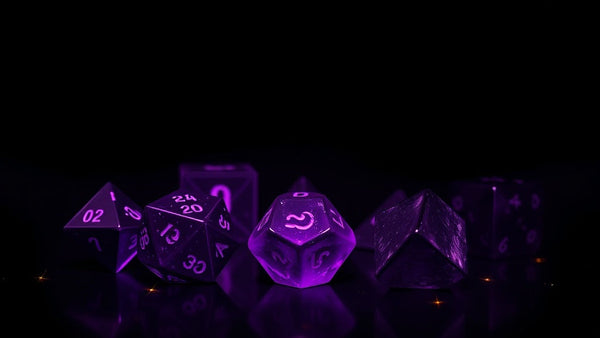
So 3d8 means "roll three eight-sided dice and add the results together." 1d20 means "roll one twenty-sided die." The format is simple, universal, and used across almost every tabletop role-playing game, not just D&D. If you are still getting familiar with the shapes and sides of each die, our guide on what dice you need for D&D is a great companion read.
How to Read Dice Notation

The fastest way to learn dice notation is to read real examples. Here is how you decode some of the most common ones you will see at the table:
- 1d20 - Roll one twenty-sided die. This is the backbone of D&D: attack rolls, saving throws, and ability checks all use 1d20.
- 2d6 - Roll two six-sided dice and add them together. A greatsword deals 2d6 slashing damage, for example.
- 8d6 - Roll eight six-sided dice and add all eight results together. This is the classic Fireball spell damage.
- 1d8+3 - Roll one eight-sided die, then add 3 to whatever you rolled. The "+3" is a fixed modifier (more on that below).
- 3d4 - Roll three four-sided dice and add them together. This is Magic Missile damage (three darts, each 1d4+1).
- 1d100 - Roll for a result between 1 and 100, usually with two ten-sided dice (a "percentile" roll). Great for random tables and loot.
The pattern is always the same: count how many dice, check how many sides, roll them all, add them up, then apply any modifier. That is the whole system.
What Does 8d6 Mean?
8d6 means "roll eight six-sided dice and add all of the results together." The 8 tells you the number of dice, the "d" tells you they are dice, and the 6 tells you each one has six faces.
The most famous use of 8d6 in D&D is the Fireball spell, one of the most iconic damage spells in the game. When a 3rd-level Fireball hits, you roll eight d6 dice and total them up for fire damage. Here is the range:
- Minimum: 8 (if every die rolls a 1, that is 8 x 1 = 8)
- Maximum: 48 (if every die rolls a 6, that is 8 x 6 = 48)
- Average: 28 (each d6 averages 3.5, and 8 x 3.5 = 28)
So when you cast Fireball, you can expect around 28 damage on a typical roll, sometimes as low as 8 on an unlucky night and up to 48 on a perfect one. Rolling eight physical d6 dice at once is genuinely satisfying, which is why many players keep a matching set of six-siders on hand. You can browse full dice sets that give you plenty of d6 dice for big damage spells like this.
What Does 2d6 Mean?

2d6 means "roll two six-sided dice and add them together." The result ranges from 2 (both dice show 1) to 12 (both dice show 6), with an average of 7.
- Minimum: 2
- Maximum: 12
- Average: 7
2d6 shows up constantly in D&D. A greatsword deals 2d6 slashing damage, a bear's bite might deal 2d6 piercing, and plenty of spells use 2d6 for their base damage. Because you are adding two dice, the results cluster toward the middle (7 is the most likely total), which makes 2d6 more consistent than a single d12 even though both can reach 12.
What Does 4d6 Mean?
4d6 means "roll four six-sided dice and add them together." The total ranges from 4 to 24, with an average of 14.
- Minimum: 4
- Maximum: 24
- Average: 14
4d6 is best known for a special version used in character creation: 4d6 drop lowest, which we cover next. You will also see plain 4d6 on some higher-damage weapon and spell effects.
The Modifier: What "+3" Means in 1d8+3

Many notations include a plus or minus sign followed by a number, like 1d8+3 or 2d6-1. This is called a modifier, and it is a fixed value you add to (or subtract from) the total after you roll.
For 1d8+3: you roll one d8 (giving you 1 to 8), then add 3. So your possible results range from 4 (rolled a 1, plus 3) up to 11 (rolled an 8, plus 3). Modifiers usually come from your character's stats, such as your Strength or Dexterity modifier on a weapon attack, or your spellcasting ability on certain spells. A longsword, for example, might read "1d8 + your Strength modifier."
The rule is simple: roll the dice first, add them together, then apply the modifier at the very end. Never multiply the modifier by the number of dice; it is a single flat bonus added once.
What Does 4d6 Drop Lowest Mean?
When you create a new D&D character, one of the most popular ways to generate your six ability scores (Strength, Dexterity, Constitution, Intelligence, Wisdom, and Charisma) is the 4d6 drop lowest method, sometimes written as 4d6d1 (the "d1" means "drop 1 die").
Here is how it works for each ability score:
- Roll four six-sided dice (4d6).
- Look at the four results and ignore (drop) the single lowest die.
- Add together the three highest dice. That total is one ability score.
- Repeat five more times to fill in all six scores.
For example, if you roll 5, 3, 6, and 2, you drop the 2 and add 5 + 3 + 6 = 14. Dropping the lowest die pushes your scores higher on average (around 12 to 13 per score) than rolling a straight 3d6, which is why it is the go-to method for building capable heroes. It is a lot of dice rolling, so this is another spot where a physical set of matched d6 dice or a quick free dice roller saves time.
Reference Table: Common Dice Notations at a Glance
Here is a quick-reference table of the dice notations you will see most often in D&D, along with their minimum, maximum, and average results. Bookmark this: it answers "what does this roll mean" for nearly every situation.
| Notation | Meaning | Min | Max | Average |
|---|---|---|---|---|
| 1d4 | Roll one four-sided die | 1 | 4 | 2.5 |
| 1d6 | Roll one six-sided die | 1 | 6 | 3.5 |
| 1d8 | Roll one eight-sided die | 1 | 8 | 4.5 |
| 1d10 | Roll one ten-sided die | 1 | 10 | 5.5 |
| 1d12 | Roll one twelve-sided die | 1 | 12 | 6.5 |
| 1d20 | Roll one twenty-sided die | 1 | 20 | 10.5 |
| 2d6 | Roll two six-sided dice, add them | 2 | 12 | 7 |
| 3d6 | Roll three six-sided dice, add them | 3 | 18 | 10.5 |
| 8d6 | Roll eight six-sided dice, add them | 8 | 48 | 28 |
How to Calculate the Average of Any Roll
The average of a single die is always the number of sides plus one, divided by two. A d6 averages (6 + 1) / 2 = 3.5, and a d20 averages (20 + 1) / 2 = 10.5. To find the average of a multi-dice roll, just multiply the single-die average by the number of dice: 8d6 is 8 x 3.5 = 28. Add any modifier at the end.
Why Dice Notation Matters
Dice notation is not just trivia; it is the practical language you use every session:
- Spell damage: Fireball is 8d6, Magic Missile is 3d4+3, and healing spells like Cure Wounds use 1d8 per level. Reading the notation tells you exactly how much to roll.
- Weapon damage: A dagger is 1d4, a longsword is 1d8, and a greatsword is 2d6. Your weapon's damage is written in dice notation on your character sheet.
- Ability checks, attacks, and saves: These almost always use 1d20 plus a modifier. The famous d20 sits at the heart of the game; learn more in our deep dive on what is a d20.
- Character creation: Rolling ability scores with 4d6 drop lowest is pure dice notation in action.
Once you can read NdX at a glance, you stop pausing to figure out what to roll and spend more time actually playing. It is one of the highest-value skills a new player can pick up.
Frequently Asked Questions
What does 8d6 mean in D&D?
8d6 means roll eight six-sided dice and add all the results together. It is most famous as the damage of a 3rd-level Fireball spell. The result ranges from a minimum of 8 to a maximum of 48, with an average of 28.
What does 2d6 mean?
2d6 means roll two six-sided dice and add them together, giving a result between 2 and 12 with an average of 7. It is the damage of weapons like the greatsword and appears in many spells and monster attacks.
What does 4d6 drop lowest mean?
4d6 drop lowest (also written 4d6d1) is a character-creation method: roll four six-sided dice, discard the single lowest die, and add the three highest together to get one ability score. Repeat six times to generate all your stats. It produces higher-than-average scores, which is why it is so popular.
What does 1d20 mean?
1d20 means roll one twenty-sided die, giving a result from 1 to 20. It is the core roll in D&D, used for attack rolls, ability checks, and saving throws, usually with a modifier added.
What does the "d" stand for in dice notation?
The "d" stands for "die" or "dice." In NdX, the number before the d is how many dice to roll, and the number after the d is how many sides each die has.
Conclusion
Dice notation looks cryptic at first, but it boils down to one simple pattern: NdX means roll N dice that each have X sides, then add them up (and apply any + or - modifier at the end). Whether it is 8d6 for a devastating Fireball, 2d6 for a greatsword swing, or 4d6 drop lowest for building your next hero, you now have everything you need to read any roll in the game with confidence.
Ready to put it into practice? Roll any notation instantly with our free dice roller, brush up on the mighty d20, make sure you have the right dice you need for D&D, and grab a fresh set from our dice sets so you always have enough six-siders for that big Fireball.