If you have spent any time around Dungeons & Dragons, you have heard someone shout "natural 20!" with pure joy. That excitement is all about one special dice: the d20, or twenty-sided die. It is the single most important dice in the game, and understanding it is the key to understanding how D&D actually works. This guide explains what a d20 is, how it is used, and how to choose a great one. We will also cover natural 20s and 1s, advantage and disadvantage, a little history, and the table superstitions that make this humble twenty-sided die the most beloved object in the hobby.
What is a d20?
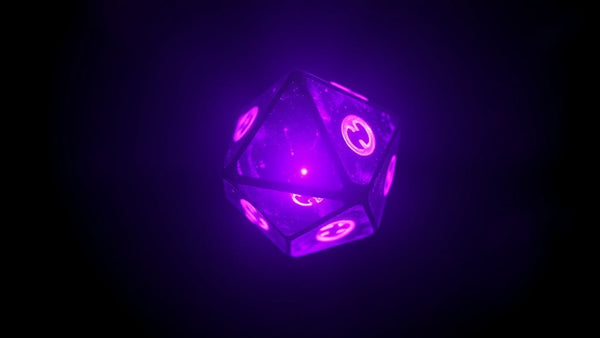
A d20 is a twenty-sided die, a near-spherical polyhedron with twenty triangular faces numbered 1 through 20. The "d" stands for "die" and the number is how many sides it has, so a d20 is simply "the twenty-sided one". It is the largest and most iconic die in a standard seven-piece polyhedral set, and it has become a symbol of tabletop gaming itself.
How the d20 is used

Almost every meaningful action in D&D is resolved by rolling a d20. Whenever the outcome is uncertain, you roll the d20, add a modifier from your character sheet, and compare the total to a target number. There are three main types of d20 roll:
- Attack rolls, to see if you hit an enemy in combat.
- Ability checks, to attempt something with your skills, picking a lock, climbing a wall, persuading a guard.
- Saving throws, to resist danger, dodging a fireball, shrugging off poison, withstanding fear.
In every case the loop is the same: roll the d20, add your bonus, and see if you meet or beat the target. That elegant simplicity is why D&D is so approachable, master the d20 roll and you understand the spine of the entire game.
Natural 20s and natural 1s
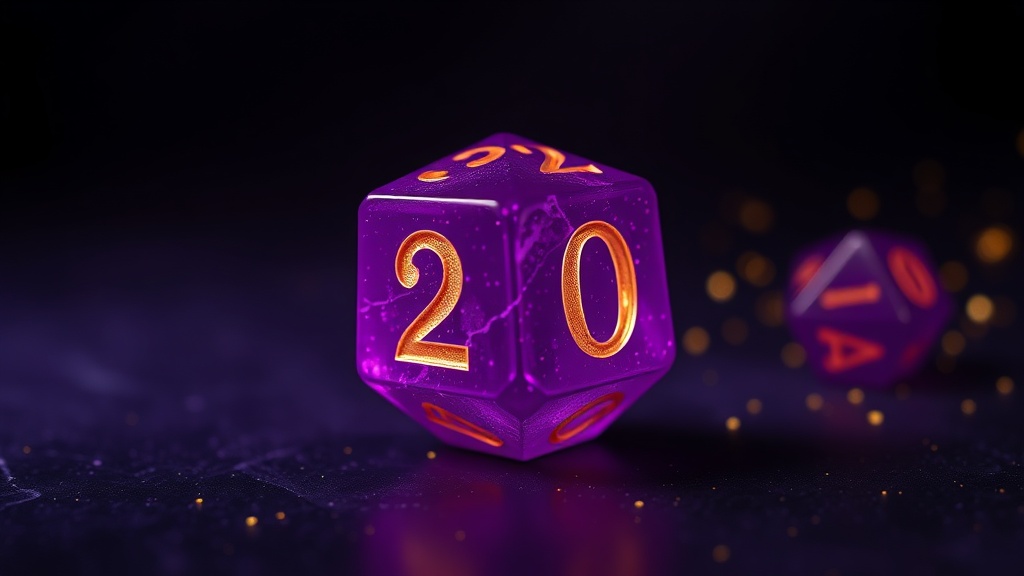
Two results on the d20 are special. A natural 20, when the die itself shows 20 before any modifiers, is a critical success. On an attack it means a critical hit, often doubling your damage dice, and it is the most celebrated moment at any table. A natural 1 is the opposite: a critical failure, an automatic miss on an attack, frequently played for dramatic (and comedic) effect. These swings of fate are a huge part of what makes rolling a d20 so thrilling, no result is ever guaranteed.
Advantage and disadvantage

The d20 also powers one of D&D's most beloved mechanics: advantage and disadvantage. When the situation favours you, you roll two d20s and keep the higher (advantage). When it works against you, you roll two and keep the lower (disadvantage). It is a clean, math-light way to represent good and bad circumstances, and it is a big reason many players like owning more than one d20, so they can roll both at once.
Why twenty sides?
The twenty-sided die gives a smooth, even spread of outcomes from 1 to 20, each with a 5% chance. That range is wide enough to make modifiers and skill bonuses meaningful, but small enough to keep the maths quick at the table. It strikes the perfect balance between luck and skill, your bonuses matter, but a lucky or unlucky roll can always change the story. That sweet spot is why the d20 sits at the centre of the game.
The d20 vs the other dice

While the d20 decides whether you succeed, the smaller dice usually decide how much. Weapons and spells deal damage with dice like the d6, d8 or d12, and healing often uses the d4 or d8. The two d10s combine for percentile rolls. So the d20 is the decision-maker, and the rest of the set fills in the details. If you want the full breakdown, see what dice you need for D&D.
Do natural 20s always succeed?
This is one of the most common questions, and the answer reveals a fun quirk of the rules. For attack rolls, a natural 20 always hits and scores a critical hit, regardless of modifiers, that part is official. For ability checks and saving throws, however, the core rules do not automatically make a natural 20 a success or a natural 1 a failure; technically your total still has to beat the target. In practice, though, many Dungeon Masters adopt a popular house rule where a natural 20 always succeeds and a natural 1 always fails on everything, because it is dramatic and fun. This is a great example of how D&D blends firm rules with table-by-table flexibility, when in doubt, ask your DM how they handle natural 20s and 1s, since every table has its own traditions.
A brief history of the d20
The twenty-sided shape is far older than tabletop gaming, examples of twenty-sided dice survive from ancient Rome and even ancient Egypt, carved from stone and glass thousands of years ago. The d20 found its modern purpose in the 1970s with the birth of roleplaying games, when designers needed a die with a wide, even range of outcomes to resolve actions. The twenty-sided die was perfect, and it quickly became the beating heart of the hobby. Today it is so iconic that it stands in for tabletop gaming as a whole, appearing on t-shirts, tattoos and logos. When you roll one, you are taking part in a tradition that stretches back millennia, and forward across millions of players worldwide.
The "d20 system" and other games
The d20 is not exclusive to Dungeons & Dragons. It gives its name to the broader "d20 System", a family of games built on the same core mechanic of rolling a d20, adding modifiers and comparing to a target number. Pathfinder, one of the most popular alternatives to D&D, uses it, as do many other roleplaying games. This is great news for new players: once you understand the d20 roll, you have effectively learned the foundation of dozens of games, and your dice work across all of them. A single quality polyhedral set is an investment in your whole hobby, not just one title.
Lucky dice and table superstition
No die inspires more superstition than the d20. Because you roll it at every crucial moment, players form genuine emotional bonds with theirs, trusting a "lucky" d20 for important rolls and benching one that betrays them with too many natural 1s. There is no science to it, of course, a fair die has no memory, but the ritual is part of the fun, and rolling a d20 you love genuinely makes you feel more confident at the table. Many collectors keep a special hero d20 reserved for the biggest moments, and choosing that die is half the joy of building a collection.
How to choose a great d20
Because you roll it more than any other die, your d20 deserves special attention. Look for:
- Readability, deep-inked, high-contrast numbers you can read across a dim table. A beautiful translucent d20 you cannot read at night will frustrate you.
- Balance, a well-made, pressure-cured or precisely cast die rolls fairly, without the bias of cheap, bubbly dice.
- Sharp, even edges, a sign of quality whether you choose resin, metal or gemstone.
- A look you love, you will reach for this die on every big moment, so pick one that makes you grin.
Many players keep a "lucky" d20 they trust for crucial rolls, and a beautiful statement d20 is one of the most satisfying pieces in any collection.
Frequently asked questions
What does d20 mean? It means a twenty-sided die. The "d" stands for die and 20 is the number of faces.
What is a natural 20? When the d20 shows 20 before modifiers, a critical success, usually a critical hit in combat.
Why do I need two d20s? To roll advantage and disadvantage in one throw instead of rolling the same die twice.
Are all d20s fair? Quality dice are; cheap mass-produced ones can be biased by bubbles or uneven edges. Buy from a reputable maker for a fair roll.
How can I test if my d20 is balanced? Float it in a glass of heavily salted water and flick it. If the same numbers keep landing face-up, the die may be biased; a fair die will show a good variety.
Why do players have a favourite d20? Because you roll it on every important moment, players bond with a "lucky" d20 they trust. It is superstition, but rolling a die you love genuinely boosts confidence at the table.
From its ancient origins to its place at the centre of every modern game, the d20 has earned its iconic status, and a great one will serve you on every adventure to come. Ready to find your hero die? Explore our full range of dice sets and pick a d20 worthy of every natural 20. Gear up. Roll to win.
What Does D20 Mean?
The short answer: d20 means "die with 20 sides." The letter "d" stands for die (the singular of dice), and the number that follows tells you how many faces that die has. So a d20 is a twenty-sided die, a d6 is your everyday six-sided cube, and a d4 is the little four-sided pyramid every player has stepped on at least once.
This shorthand is called dice notation, and it is written as "dX," where X is the number of faces. It became the standard way tabletop gamers describe dice because it is fast and unambiguous. When a rulebook tells you to "roll 2d6," it means roll two six-sided dice and add the results. "1d20" simply means roll a single twenty-sided die. Once you know the pattern, you can read any dice instruction in a game manual at a glance.
Where the "dX" Notation Comes From
Dice notation grew up alongside the earliest tabletop roleplaying games in the 1970s. Designers needed a compact way to print dice instructions in rulebooks and on character sheets, and "dX" fit the bill. It has since spread far beyond fantasy roleplaying into wargames, board games, and video game mechanics. The format is consistent everywhere you find it: the "d" always means die, and the number always means faces. That is why "d20 full form" really just expands to "twenty-sided die."
D20 Can Also Mean the D20 System
There is a second thing "d20" can point to, and it trips up a lot of newcomers. Beyond the physical die, "the d20 System" refers to a family of game rules built around rolling a twenty-sided die for most actions. Published under the Open Game License (OGL), the d20 System became the shared engine behind Dungeons and Dragons Third Edition and many other games. So when someone says "a d20," they almost always mean the die you hold in your hand. When someone says "the d20 system," they mean the rules framework that uses that die as its core mechanic. Same three characters, two different meanings, and the context tells you which one is intended.
Why the D20 Is Central to D&D
The twenty-sided die earns its starring role because Dungeons and Dragons resolves almost every uncertain moment with a single d20 roll. You roll it to see whether you land an attack, to make saving throws against danger, and to make ability checks when you try something risky. In each case you roll the d20, add the relevant modifier, and compare the total to a target number.
- Attack rolls decide whether your strike connects with an enemy.
- Saving throws let you resist spells, traps, and other hazards.
- Ability checks cover skills like climbing, persuading, or searching.
Twenty faces give a wide, even spread of outcomes, which keeps results exciting without being wildly swingy. Want to feel it for yourself? You can roll a d20 with our dice roller to see the range in action, or pick up a set of your own from our dice sets and bring the full standard lineup to your table.
So the next time you hear "d20," you will know exactly what it means: twenty sides, one die, and the beating heart of tabletop roleplaying.