If you have ever sat down for a game of Magic: The Gathering or Dungeons and Dragons, you have almost certainly held both a standard D20 and a spindown die, even if you did not realize they were different tools. At a glance they look like twins: both are twenty-sided icosahedrons, both are numbered 1 through 20, and both fit neatly in the palm of your hand. Yet spindown dice and standard D20s are built for opposite jobs, and using the wrong one at the wrong moment can quietly wreck the fairness of your game. This guide breaks down exactly what separates spindown dice from a true D20, why that difference exists, and how to make the right call every time you reach into your dice bag.
Understanding spindown dice is not just trivia for collectors. It touches the core of how you track resources, resolve random outcomes, and keep a table honest. Once you see how the numbers are arranged, you will never mix these two dice up again, and you will understand why competitive players guard the distinction so closely.
What Are Spindown Dice?
Spindown dice are twenty-sided dice designed as counters rather than randomizers. The defining trait is the layout of their numbers. On a spindown die, the values run in a continuous descending spiral: 20 sits next to 19, which sits next to 18, and so on all the way down to 1. Because the sequence is arranged in adjacent order, you can "spin down" the die one number at a time simply by rotating it to the neighboring face. This makes it effortless to decrement a total by a single point without hunting across the die for the next value.
This design was popularized by trading card games, most famously Magic: The Gathering, where each player begins with a life total of 20. A spindown die is the perfect companion for that format because you can rotate it face by face as you lose life, watching the count tick down in a clean, predictable path. Planeswalker loyalty counters, commander damage in smaller ranges, and countdown timers for effects all benefit from the same smooth spiral. In short, spindown dice exist to make counting fast and error resistant.
How a Standard D20 Is Different

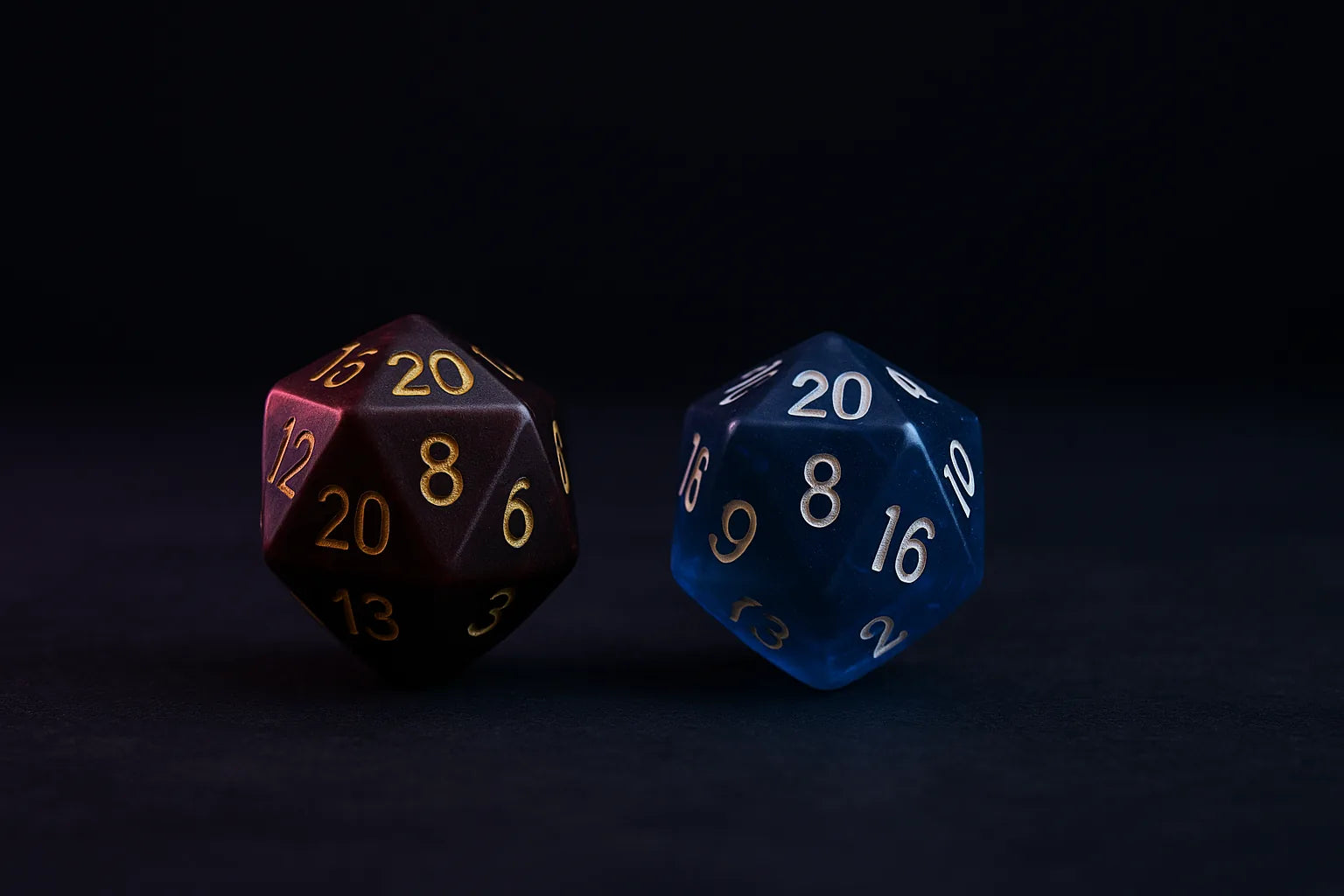
A standard D20, the kind used for rolling in Dungeons and Dragons and countless other tabletop role playing games, is engineered for the exact opposite purpose. Its numbers are deliberately scattered across the surface so that no two adjacent faces are close in value. High numbers sit beside low numbers, and the arrangement is balanced so that any region of the die contains a mix of large and small results. This scattering is intentional, and it is the single most important reason you should never confuse a D20 with a spindown die.
The scattered layout serves a statistical goal. When a die is manufactured, tiny imperfections in weight, shape, or balance are inevitable. If high numbers were all clustered on one side, those imperfections could bias the die toward high or low rolls. By distributing the numbers so that opposite faces always add up to 21 and neighboring faces vary wildly, a proper D20 spreads any physical bias evenly across the full range of outcomes. The result is a roll that is as close to truly random as a physical object can be.
Why the Number Arrangement Matters So Much
Here is the heart of the spindown dice versus D20 debate. Because a spindown die groups its numbers into an ordered spiral, it is a genuinely poor tool for random rolls. Any manufacturing flaw, any slight imbalance, gets amplified rather than canceled out. If a spindown die is even a little heavier on one side, it will tend to land on a cluster of similar numbers far more often than chance would predict. Since those numbers are all near each other on the die, you could see a noticeable skew toward, say, the high teens or the low single digits.
For a life counter, that bias does not matter at all. You are not rolling the die to generate a result; you are setting it deliberately and rotating it by hand. But the moment you use that same spindown die to roll for initiative, an attack, or a saving throw, the bias becomes a real problem. Two players rolling the same spindown die might unknowingly enjoy consistently different luck, and in a competitive setting that is unacceptable. This is precisely why tournament organizers and experienced dungeon masters insist that spindown dice stay in their lane as counters, never as randomizers.
When to Use Spindown Dice

Spindown dice shine in any situation where you need to track a number that changes steadily up or down. Reach for a spindown die when you are:
- Tracking your life total in Magic: The Gathering, where you start at 20 and count down.
- Managing planeswalker loyalty counters or other slowly shifting values.
- Running a countdown timer for a spell, ability, or turn based effect.
- Keeping score in casual games where the range fits neatly within 1 to 20.
- Teaching new players, since the smooth spiral makes the current total easy to read at a glance.
The ergonomics are the whole point. Because you only ever move to an adjacent face, you rarely make an error, and anyone watching can verify the count instantly. Many players keep a distinctly colored spindown die on hand purely so it is impossible to mistake for their rolling dice.
When to Use a Standard D20
A standard D20 is the tool you want any time the outcome must be fair and unpredictable. Use a true D20 when you are:
- Rolling for attacks, damage, or saving throws in Dungeons and Dragons or other role playing games.
- Determining initiative order at the start of combat.
- Resolving any check where randomness must be trustworthy and unbiased.
- Playing in a tournament or organized event where rules require balanced dice.
- Settling a dispute or coin flip style decision where both sides need an even shot.
If fairness is on the line, the scattered numbering of a proper D20 is doing invisible but essential work. A well made role playing die is often manufactured to tighter tolerances precisely because its job is to be random, whereas a counter die can be a little looser without any consequence.
Equity and Fairness at the Table

The fairness question deserves special attention because it is where the spindown dice versus D20 distinction stops being academic. Imagine a group that grabs whatever twenty sided die is closest when someone calls for a roll. If half those dice are spindown dice, the table is no longer running on equal footing. Some rolls will lean high, some will lean low, and no one will understand why certain players seem luckier than others. Over a long campaign or a tournament bracket, those small biases compound into real, unearned advantages.
This is why the golden rule is simple: keep your counters and your randomizers physically separate. A quick trick is to buy your spindown dice in a color you never roll with, so a glance at the table tells you instantly which die is a counter and which is fair game for a roll. Competitive Magic players often carry a dedicated life counter die for exactly this reason, and seasoned dungeon masters will politely swap out any spindown die that wanders into the rolling pile. Protecting the integrity of the roll protects the fun for everyone.
A Short History of the Spindown Die
The spindown die is a relatively modern invention, born out of the trading card game boom of the 1990s. When Magic: The Gathering standardized a starting life total of 20, players needed a fast, reliable way to track that number as it dropped. Early on, people used pen and paper, glass beads, or clusters of ordinary dice, but none of those solutions were as elegant as a single twenty sided die you could simply rotate. Manufacturers responded by rearranging the familiar D20 into an ordered spiral, and the spindown die was born. Today many card game products include a branded spindown die right in the box, which is one reason so many hobbyists own a drawer full of them without ever thinking about how they differ from rolling dice.
That history also explains a common source of confusion. Because spindown dice are handed out so freely with card game sets, they tend to migrate into general dice collections. A player who owns dozens of them may not realize that none of those spiral numbered dice are suitable for a fair role playing roll. Knowing the origin story helps you spot the interloper and set it aside for its proper counting duty.
How to Buy the Right Dice
When you shop for dice, the packaging usually tells you what you are getting, but the surest test is to look at the numbers themselves. Pick up the die and trace the values: if 20, 19, 18, and 17 sit next to each other in a neat descending path, you are holding a spindown die meant for counting. If the numbers jump around with no obvious order and opposite faces add to 21, you have a proper D20 built for rolling. A few practical tips make the buying decision easier:
- Buy a dedicated spindown die in a distinct color reserved only for life tracking.
- Choose a well balanced, precision made D20 for any role playing or competitive rolling.
- Check listings for the words "spindown" or "counter" versus "gaming" or "RPG" dice to know the intended use.
- If you play both card games and role playing games, keep two clearly separated sets so they never mingle.
A modest investment in the right dice pays off in smoother games and fewer arguments. You do not need anything expensive; you simply need to match the tool to the task.
Conclusion
Spindown dice and standard D20s may share the same twenty sided silhouette, but they were designed to solve different problems. Spindown dice arrange their numbers in a smooth descending spiral so you can track life totals, loyalty, and countdowns with a single confident rotation. A standard D20 scatters its numbers to guarantee fair, unbiased rolls for combat, initiative, and every check where luck must be honest. Use spindown dice as counters, use a true D20 as a randomizer, and never let the two cross over into each other's job. Master that one distinction and you will run a cleaner, fairer, and altogether smarter table, whether you are shuffling up in a card game or diving into a dungeon.