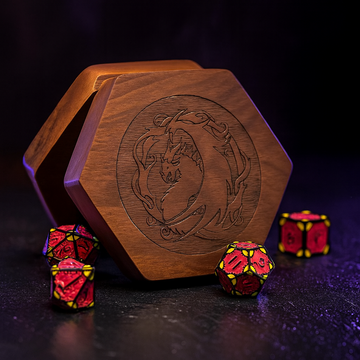
Anyone who has spent time at a gaming table quickly learns that not all polyhedrals are created equal. Dice sizes range from tiny 10mm micro cubes barely wider than a pencil eraser to towering giant d20s that dominate a shelf. Understanding dice sizes matters more than most players expect, because the diameter of a die shapes how it reads across the table, how it feels in your hand, how it rolls, and how much space it eats in your bag. This guide walks through the full spectrum of dice sizes so you can choose confidently, whether you are building a first set, hunting for travel dice, or looking for a showpiece.
Why Dice Sizes Matter More Than You Think
At first glance, size seems like a cosmetic detail. In practice, it touches nearly every part of the experience. Larger dice are easier to read from across a wide table, which speeds up play and reduces the constant leaning and squinting that slows a session. Smaller dice pack neatly into travel kits and let you carry several full sets without weighing down a bag. The heft of a die also changes how it tumbles: a bigger, heavier die settles quickly and feels satisfying, while a tiny die can skitter and bounce unpredictably. When you understand the trade offs baked into different dice sizes, you stop buying blindly and start matching the die to the job.
There is also an ergonomic angle. Players with larger hands often find standard dice fiddly, especially when scooping up a fistful of them for a big damage roll. Players who prize precision and control might prefer a slightly larger die that seats firmly between the fingers. None of this is about right or wrong. It is about knowing what each option gives you before you commit.
The Full Range of Dice Sizes at a Glance

Before diving into each category, it helps to see the common dice sizes laid out together. The measurement almost always refers to the width of a d6 across its flat faces, or the edge to edge span of a d20, expressed in millimeters. Here is a quick reference table of the sizes you will encounter most often.
- 10mm mini dice: The smallest widely sold option. Ultra compact, ideal for travel and tight spaces, but demanding on the eyes.
- 12mm small dice: A step up from minis. Popular for board games that need many d6s, and for players who want a light, pocketable set.
- 16mm standard dice: The default size for most polyhedral sets and tabletop role playing games. The balance point of the entire range.
- 19mm to 20mm large dice: Noticeably chunkier. Easier to read and pleasant to handle, favored by players who want presence without going oversized.
- 25mm and up: Oversized dice that read clearly from anywhere at the table and work well as focal pieces.
- Giant and jumbo dice (50mm and beyond): Display and novelty territory. Enormous d20s and foam giants meant for spectacle, group rolls, and collectors.
10mm and 12mm Mini Dice: Small but Mighty
Mini dice sizes exist for one main reason: portability. A 10mm die is roughly the width of a fingernail, and a full set of them disappears into a coin pouch. If you travel often, run games in cramped spaces, or simply want a discreet backup set, minis are hard to beat. They also shine in games that call for large handfuls of matching d6s, since a pile of 10mm cubes takes up far less room than the same count at standard size.
The trade offs are real, though. Numbers on 10mm and 12mm dice are small and can be tough to read in dim lighting or for anyone with less than perfect vision. Some designs cram the digits so tightly that certain numbers blur together at a glance. Mini dice are also light, so they bounce and scatter more than heavier options, which can send them skittering off the edge of the table. For quick reference, a 6 and an 8 or a 3 and a 9 can look alike on the smallest faces, so favor sets with clean, high contrast inking. Use minis where compactness is the priority, and pair them with a small rolling tray to keep the chaos contained.
16mm Standard Dice: The Reliable Default

If you are unsure where to start, 16mm is the answer for the overwhelming majority of players. This is the size that most polyhedral sets ship in, the size game stores stock by default, and the size that strikes the cleanest balance across every consideration. A 16mm die is small enough to gather several into a comfortable handful yet large enough that the numbers read clearly under normal table lighting. It rolls well, sits nicely in a dice tray, and fits standard storage solutions without fuss.
Standard dice sizes also enjoy the widest selection by a huge margin. Whatever material, color, finish, or theme you want, you will find it first and most abundantly at 16mm. Metal sets, resin sets, sharp edged precision dice, glow in the dark options, and gemstone dice all appear here before any other size. For a first purchase, a daily driver set, or a gift, 16mm is the safe, sensible, and versatile choice that will never feel out of place at any table.
19mm and 20mm Large Dice: Presence and Readability
Stepping up to the 19mm to 20mm range brings a noticeable jump in presence. These larger dice sizes feel substantial in the hand, and the extra surface area makes the numbers easy to read from across a wide table. Players who run games for a group, or who sit at a large table where the action happens a few feet away, often gravitate here because it cuts down on the constant craning to see a result. The added weight also gives each roll a more deliberate, satisfying tumble.
The cost of going larger is mostly practical. A handful of 20mm dice takes up more space, so gathering many of them for a big roll is less convenient than with standard sizes. Storage and carrying cases designed for 16mm sets may not accommodate the bigger dice, so plan accordingly. Selection is also narrower than at standard size, though it remains healthy, especially for signature d20s. For players who prioritize readability and a premium feel over compactness, this range hits a genuinely appealing sweet spot.
Giant and Jumbo Dice: Spectacle and Display

At the far end of the spectrum sit giant and jumbo dice, ranging from around 25mm oversized pieces to enormous 50mm and larger d20s, plus foam giants that can be tossed across a room. These dice sizes are less about everyday play and more about spectacle, ceremony, and display. A giant d20 makes a striking centerpiece on a shelf, a memorable prop for a climactic roll, or a shared communal die that a whole group can rally around for a dramatic moment.
Practicality takes a back seat here. A jumbo die needs real space to roll and will not fit any normal case, so it lives on a desk or shelf rather than in a bag. Foam and lightweight giants are safe to toss and fun for parties and events, while heavy resin or metal giants are showpieces meant to be admired and rolled sparingly. Nobody plays a full campaign with a 55mm d20, but as a collector item, a gift, or a table centerpiece, giant dice deliver a wow factor that no standard set can match.
How to Choose the Right Dice Sizes for You
Picking among the various dice sizes comes down to a few honest questions about how and where you play. Start with your table and eyesight: if you frequently struggle to read results from across the table, lean toward 19mm or 20mm dice for their clarity. If you play in tight quarters, travel with your games, or want backup sets that vanish into a pocket, 10mm or 12mm minis earn their place. For everything in between, and for anyone who just wants one dependable set that does it all, 16mm standard remains the default for good reason.
Consider your hands too. Players with larger hands often prefer standard or large dice that seat comfortably between the fingers, while those who scoop up big handfuls of d6s may accept smaller sizes to keep the pile manageable. Storage is the final piece: match your dice sizes to the trays, pouches, and cases you already own, or budget for new ones if you go oversized. When you shop, check the listed millimeter measurement rather than trusting a photo, since scale is notoriously hard to judge from images alone. Read the specifications, confirm the size fits your storage, and favor sellers who state dimensions clearly.
Final Thoughts on Dice Sizes
Dice sizes are one of those details that quietly shape the whole experience, from readability and comfort to storage and sheer table presence. There is no single best size, only the size that fits how you play. Minis reward portability, standard 16mm dice offer the best all around balance and the widest selection, large dice trade a little convenience for clarity and heft, and giant dice exist to impress. Once you understand what each range gives you, choosing becomes simple. Measure your needs, match them to the right dice sizes, and you will end up with a set that feels right in your hand and reads clearly on your table for years of play.