If you have ever stood in front of a wall of sleeve packs wondering why some fit your cards like a glove and others leave awkward gaps, you are not alone. Understanding card sleeve sizes is one of the most overlooked skills in the trading card hobby, yet it is the single thing that protects your collection from wear, bends, and dust. The truth is that not all cards are the same dimensions, and matching the right sleeve to the right card is what separates a well kept binder from a shelf full of frustration. In this guide we break down every major sleeve category, explain which games use which format, and give you the exact measurements so you never buy the wrong pack again.
Whether you play Magic: The Gathering, Pokemon, Disney Lorcana, One Piece, Yu-Gi-Oh, or you are protecting components in your favorite board game, the same core principles apply once you learn them. Let us make card sleeve sizes simple.
Why Card Sleeve Sizes Matter More Than You Think
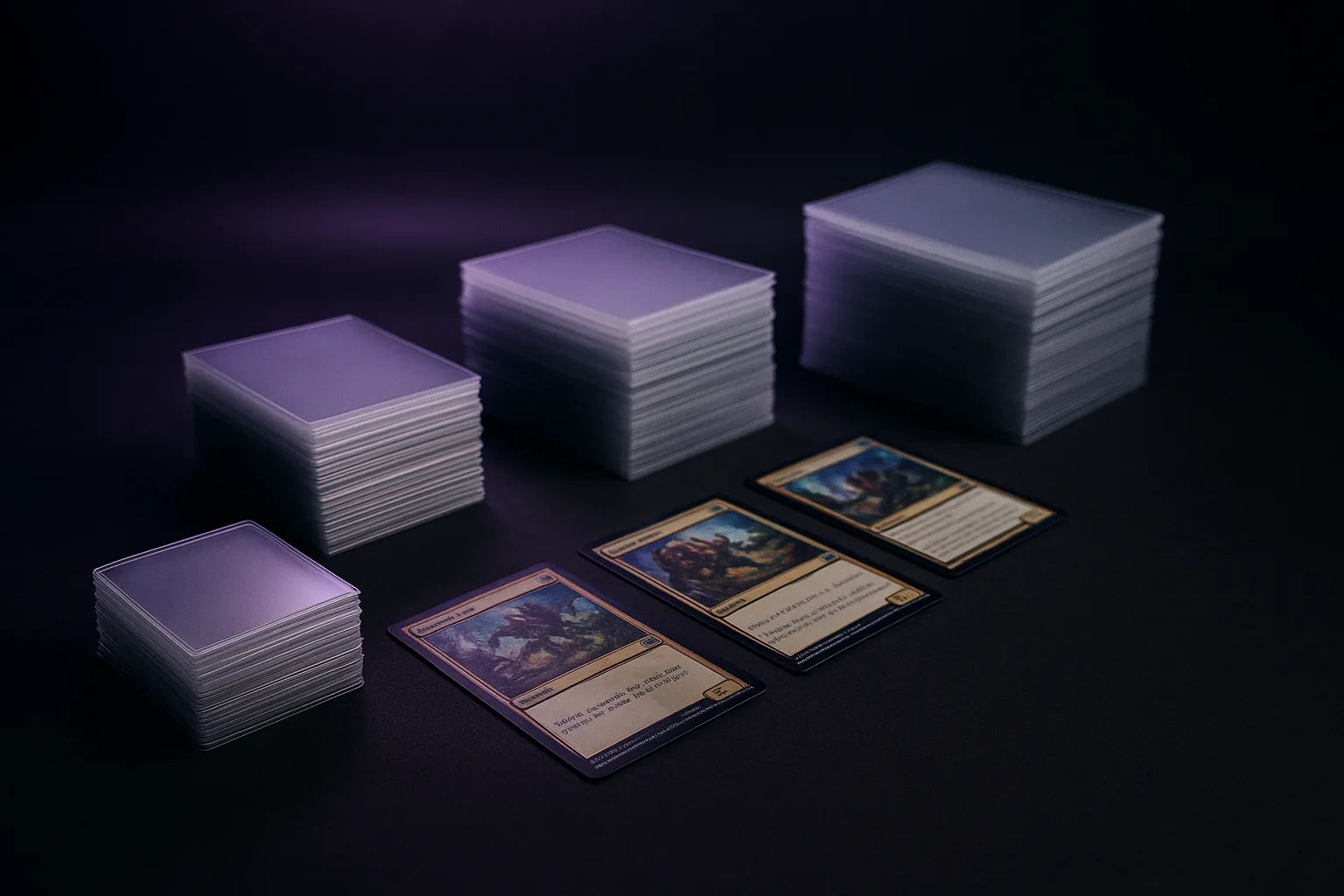
A sleeve that is too large lets the card slide around inside, which allows dust to creep in and lets the corners rub against the plastic every time you shuffle. A sleeve that is too small forces the card in, bowing it and stressing the edges until you see permanent creasing. The correct card sleeve sizes hug the card snugly on the two long sides while leaving a small amount of headroom at the top so the card can breathe and be removed without damage.
Beyond protection, sleeve fit affects gameplay. Tournament players care deeply about card sleeve sizes because a poorly fitting sleeve can mark a card, and marked sleeves are grounds for penalties in sanctioned events. A tight, consistent sleeve also shuffles cleaner and feels better in hand. So this is not just about preservation, it is about performance at the table too.
Standard Card Sleeve Sizes: The 66x91 Format

The most common category by far is the standard size, sometimes called regular size. Standard card sleeve sizes are built to fit cards that measure roughly 63 by 88 millimeters, and the sleeves themselves come in around 66 by 91 millimeters to leave a comfortable margin. This is the format you reach for the vast majority of the time.
Standard sleeves fit the following games:
- Magic: The Gathering (MTG) uses the classic 63 by 88 mm card, the original template for standard sleeves.
- Pokemon TCG cards share the same 63 by 88 mm footprint and fit standard sleeves perfectly.
- Disney Lorcana also uses the standard size, so your MTG sleeves will work here too.
- One Piece Card Game is standard sized as well, which is convenient for players who dabble across multiple games.
- Flesh and Blood, Star Wars Unlimited, and most modern western TCGs follow the standard format.
Because so many games converge on this one size, buying standard sleeves in bulk is the smartest move for any multi game collector. When someone talks about card sleeve sizes without specifying, they almost always mean standard.
Japanese and Small Card Sleeve Sizes: The 62x89 Format
The second big category is the japanese size, also called small size or yugioh size. These card sleeve sizes fit cards that measure about 59 by 86 millimeters, with sleeves running near 62 by 89 millimeters. The slightly narrower and shorter dimensions matter because a standard sleeve on a small card leaves too much slack.
Games that use small or japanese card sleeve sizes include:
- Yu-Gi-Oh! is the headline game here, with its 59 by 86 mm cards that need small sleeves for a snug fit.
- Many japanese TCGs and imported card games use this smaller footprint, which is why the size is often labeled japanese.
- Cardfight Vanguard and Weiss Schwarz also fall into the small sleeve category.
A common beginner mistake is sleeving Yu-Gi-Oh cards in standard sleeves. They technically fit, but the extra room lets cards shift and looks sloppy in a deck box. Matching Yu-Gi-Oh to small card sleeve sizes is the professional choice.
Perfect Fit and Inner Sleeves: Double Sleeving Explained

Serious collectors and competitive players often double sleeve, and this is where a special category of card sleeve sizes comes into play. Perfect fit sleeves, also called inner sleeves, are tight clear sleeves sized to hug the card with almost no margin at all. For standard cards, a perfect fit sleeve runs about 64 by 89 millimeters, barely larger than the card itself.
The technique works like this. You slide the card into a snug perfect fit inner sleeve first, then place that combination into a regular standard outer sleeve. The inner sleeve seals dust out from the top, while the outer sleeve provides grip, opacity, and shuffle durability. Perfect fit sleeves come in two orientations, top loading and side loading, and side loading is generally preferred for double sleeving because it fully encloses the card.
Understanding these smaller card sleeve sizes is essential if you own valuable or graded worthy cards. The extra layer dramatically reduces edge wear and keeps moisture out during long term storage.
Oversized and Specialty Card Sleeve Sizes
Not every card is standard or small. Some cards break the mold entirely, and there are dedicated card sleeve sizes for them. Oversized cards, such as MTG commander display cards, planechase cards, and various promo or jumbo cards, require oversized sleeves that can run 100 by 140 millimeters or larger depending on the product.
Tarot sized sleeves and large format game cards also fall into this specialty bracket. If you collect promotional jumbo cards from Pokemon or oversized commander cards, do not assume a standard sleeve stretched to its limit will work. Buy the correct oversized card sleeve sizes and your cards will stay flat and protected. Specialty sleeves are less common on shelves, so it is worth measuring your card first and confirming the exact dimensions before ordering.
Board Game Card Sleeve Sizes: A Whole Different World

Board games are where card sleeve sizes get genuinely complicated, because there is no single standard. Different publishers use wildly different card dimensions, so sleeve manufacturers produce a whole spectrum of board game card sleeve sizes named by their measurements. Here are the most common ones you will encounter:
- Mini American: 41 by 63 mm, used in games like Race for the Galaxy and 7 Wonders.
- Mini European: 44 by 68 mm, common in many euro style titles.
- Standard American (Chimera): 57 by 89 mm, used in Munchkin, Dominion, and many American designed games.
- Standard European: 59 by 92 mm, found in Catan, Carcassonne, and Ticket to Ride.
- Standard Card Game: 63 by 88 mm, matching poker sized playing cards and many TCGs.
- Tarot: 70 by 120 mm, used in games with large event or role cards.
- Square sizes: ranging from 70 by 70 mm upward for games that use square cards.
The lesson here is that you cannot buy board game sleeves blindly. Always measure the cards in your specific game, then match them to the closest board game card sleeve sizes. Many hobbyists keep a small measuring guide handy precisely because these formats vary so much between publishers.
How to Measure Card Sleeve Sizes Correctly
Measuring your cards before buying sleeves takes thirty seconds and saves you from wasted money. Use a millimeter ruler and follow these steps to nail your card sleeve sizes every time.
- Lay the card flat and measure the width across the shortest side first, then the height along the longest side.
- Record both numbers in millimeters, since sleeve packaging almost always lists dimensions this way.
- Add roughly 2 to 3 millimeters to each dimension to find the ideal sleeve size, because the sleeve must be slightly larger than the card.
- Compare your result to the standard categories: 63 by 88 mm points to standard sleeves, 59 by 86 mm points to small or japanese sleeves.
- For board game cards that do not match a TCG size, match to the closest named board game format from the list above.
When you are unsure between two card sleeve sizes, choose the slightly larger option. A touch of extra room is far safer than forcing a card into a sleeve that is too tight and risking a bent corner.
Common Mistakes to Avoid With Card Sleeve Sizes
Even experienced collectors slip up. Here are the errors that come up most often once you start paying attention to card sleeve sizes.
- Using standard sleeves for Yu-Gi-Oh: The cards fit loosely and shift around. Always use small or japanese sleeves for these.
- Mixing sleeve brands in a tournament deck: Slight differences in card sleeve sizes and finish between brands can make a deck feel marked. Keep every sleeve in a competitive deck identical.
- Forgetting inner sleeve tolerance when double sleeving: Some outer sleeves are too tight to hold a double sleeved card. Confirm the outer sleeve has enough room before committing to a full deck.
- Buying board game sleeves without measuring: Publishers vary so much that guessing almost always leads to a poor fit. Measure first, every time.
- Ignoring headroom at the top: A card that reaches the very top of the sleeve is hard to remove and picks up dust. Proper card sleeve sizes leave a small gap at the opening.
Final Thoughts on Choosing the Right Card Sleeve Sizes
Once you internalize the core categories, card sleeve sizes stop being intimidating. Remember the two anchors: standard at 66 by 91 mm for MTG, Pokemon, Lorcana, and One Piece, and small or japanese at 62 by 89 mm for Yu-Gi-Oh. From there, perfect fit inners let you double sleeve valuable cards, oversized sleeves handle jumbo and commander pieces, and the named board game formats cover everything from Munchkin to Catan.
The single most valuable habit you can build is measuring before you buy. A ruler and thirty seconds of attention will always beat guessing. Keep a small stock of standard sleeves for your most common games, add small sleeves if you play Yu-Gi-Oh, and reference the board game size chart whenever you sleeve a new title. Do that, and your collection will stay crisp, tournament ready, and protected for years. Mastering card sleeve sizes is a small effort that pays off every single time you shuffle up and play.